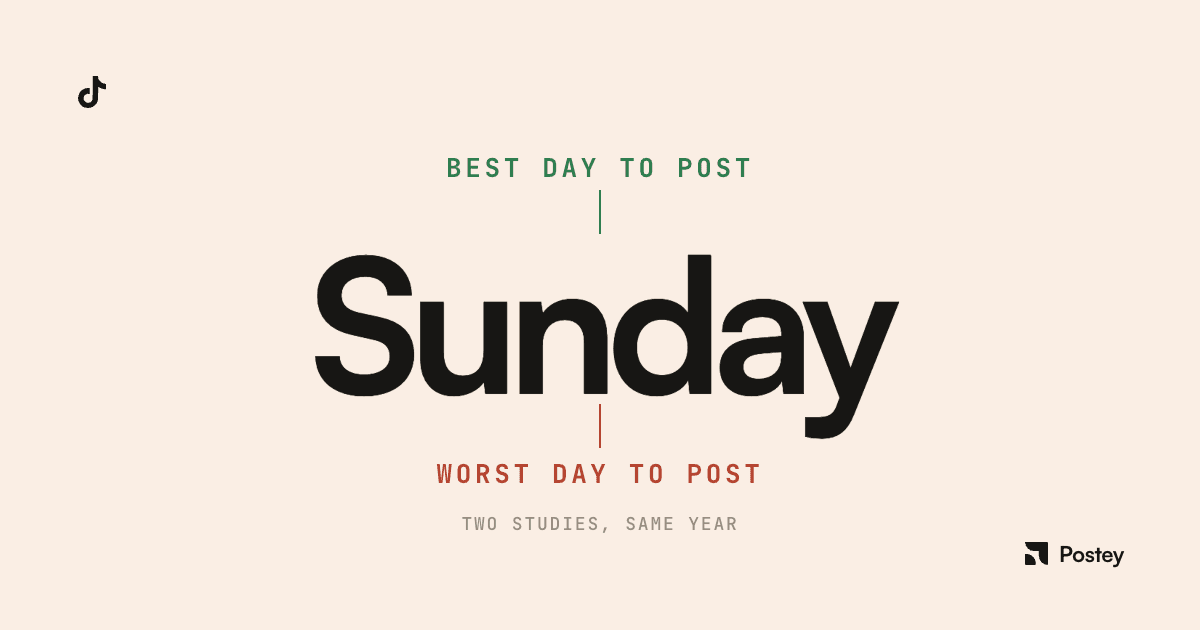
Buffer analyzed 7.1 million TikTok posts and found Sunday is the best day. Sprout Social analyzed 2 billion engagements and found Sunday is the worst.
Both studies are real, recent, and huge. They can't both be right, and that tells you more about TikTok timing than either chart does.
Three big datasets, three incompatible answers
- (7.1 million posts, July 2026): Sunday 9 a.m. is the top slot, Saturday the best day, afternoons the weakest window.
- (2 billion engagements, 307,000 profiles, March 2026): Tuesday through Friday, 2–6 p.m.; Sundays are the worst day, Saturdays close behind.
- (2.3 million posts, 92,000 accounts, mid-2026): views concentrate 6–9 p.m. every day, peaking around 8 p.m., a third answer neither of the others gives.
When three serious datasets disagree this violently, each one mostly describes its own users (who they are, where they live, when they post), not a law of the platform.
TikTok's own algorithm docs never mention posting time
TikTok's ranking guidance lists what ranks videos: how users interact (likes, shares, follows, watch-throughs), video information (captions, sounds), and device settings. Watching to the end outweighs weak signals. Follower count is not a direct factor.
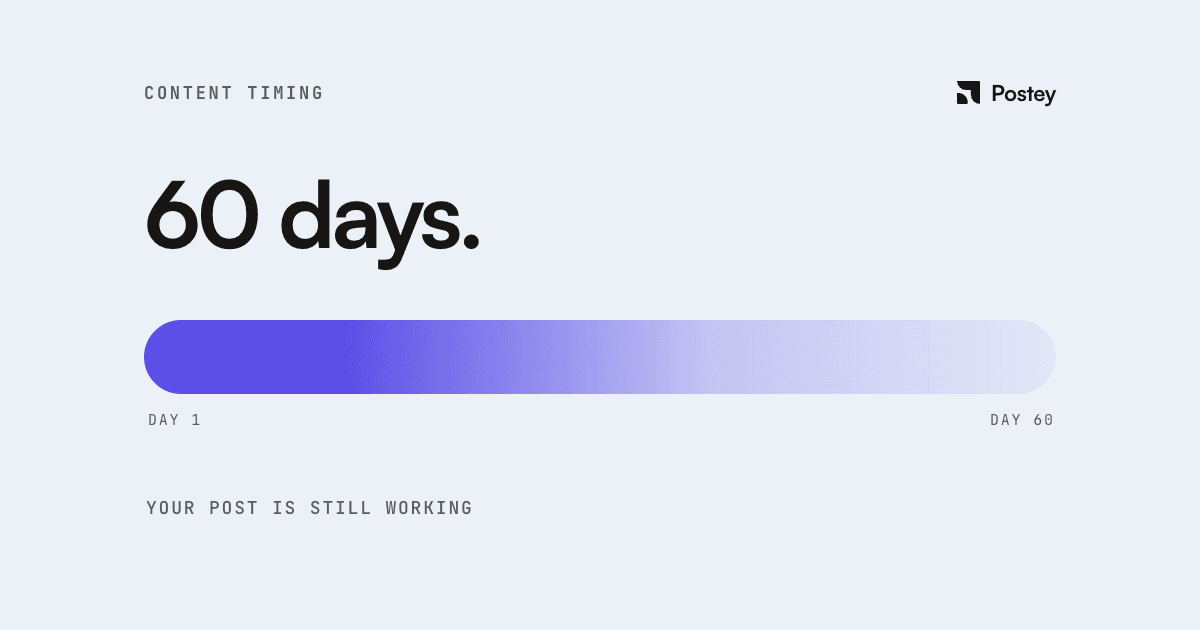
Posting time appears nowhere in that list. The distribution data explains why: 73% of video views come from the For You page, and videos collect 96% of their lifetime reach across their first 10 days, not their first hour. A video that hooks people spreads for a week regardless of when it went up.
The real story is saturation, not scheduling
Metricool's year-over-year numbers are worth staring at: posting volume rose 72% while average views per video fell 31%. The pie didn't shrink; the number of forks went up.
That's the environment you're optimizing in. When supply grows that fast, the edge from posting at 8 p.m. instead of 3 p.m. is nothing next to a video whose first three seconds stop the scroll and that people watch to the end.
What to do with all this
- Default to evenings in your audience's timezone. It's the only window with cross-study support, and it costs you nothing.
- Post consistently for three weeks, then read your own data. TikTok Studio shows when your viewers are active; your account's answer beats every global chart in this article.
- Spend your effort on completion, not clocks. Watch-throughs and shares are what TikTok says it ranks on. A stronger hook is worth more than a better hour.
- Batch the scheduling so it stops eating creative time. Write a week of posts in one sitting and let your scheduler publish them at your chosen evening slots. This is the boring thing Postey is built for: draft once, and it queues tailored versions across your platforms while you make the next video.
The uncomfortable truth about TikTok timing: everyone selling you a magic hour is describing their own customer base. Pick evenings, be consistent, make the first three seconds count, and let your own analytics, not a chart, refine it from there. If you want the queue handled while you focus on the videos, try Postey.